CESDRR and MODSNOW: Advancing Risk Monitoring to a New Level
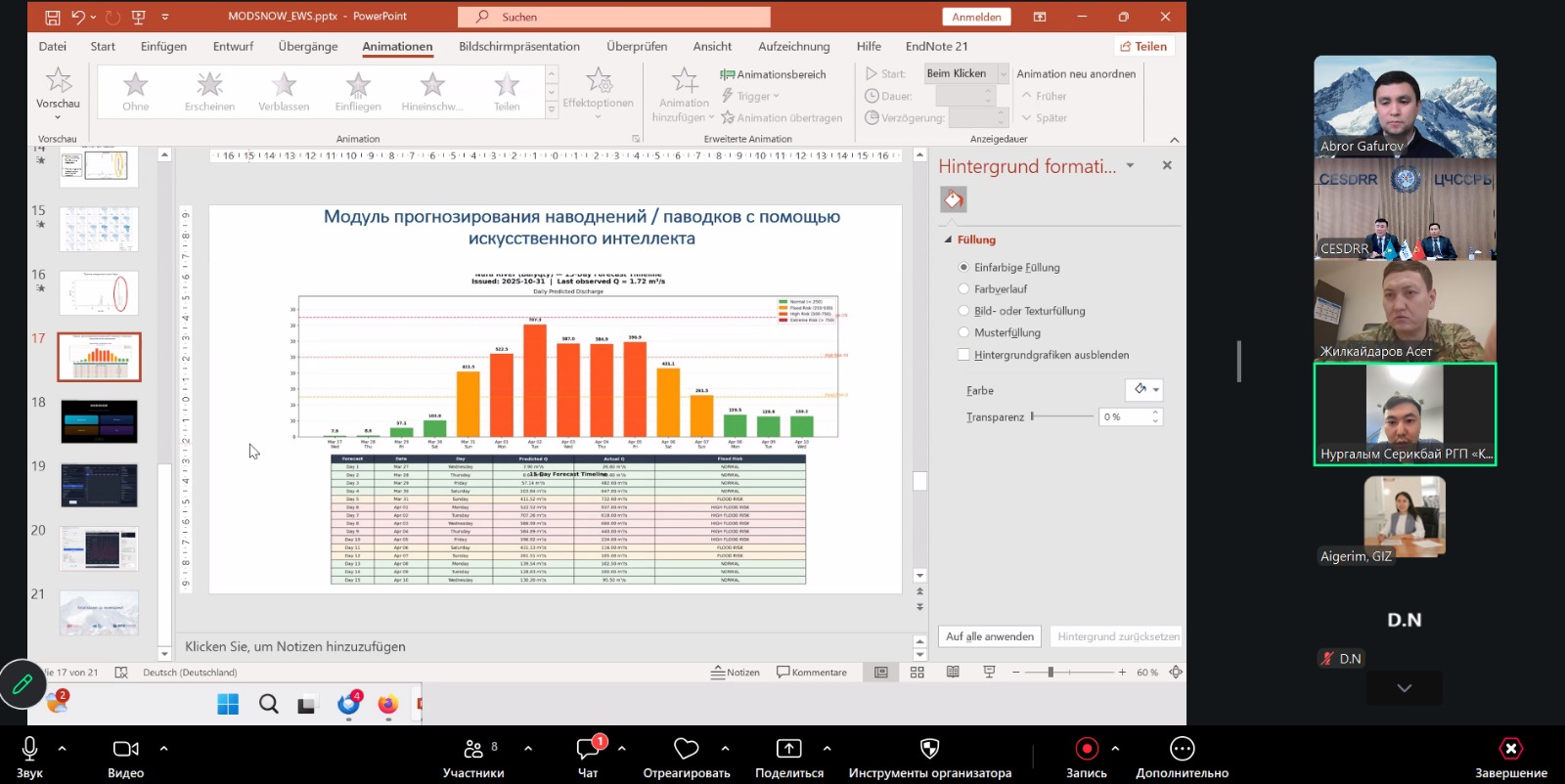
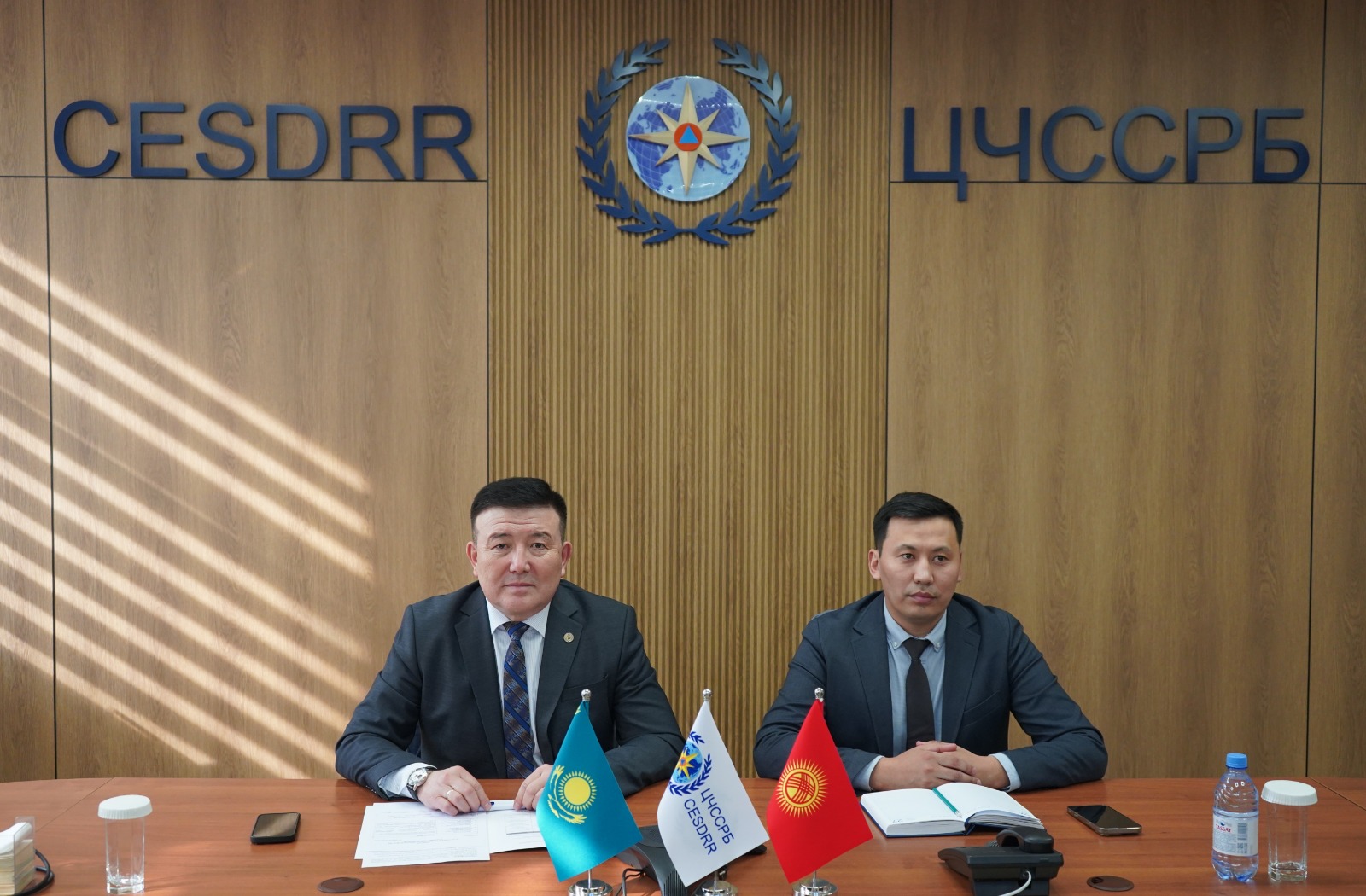
On March 20, 2026, the Center for Emergency Situations and Disaster Risk Reduction, jointly with the Ministry of Emergency Situations of the Republic of Kazakhstan, held an online working meeting to discuss the technical capabilities, conditions, and prospects for integrating the MODSNOW software platform into the operational practice of the authorized bodies of the Republic of Kazakhstan.
The meeting brought together representatives of the Committee for Emergency Prevention of the Ministry of Emergency Situations of the Republic of Kazakhstan, the State Institution “Kazselezashchita,” RSE “Kazhydromet,” as well as technical experts and developers of the MODSNOW platform.
Opening the meeting, a representative of the Center noted that the MODSNOW platform, presented by the developer with the support of the German Agency for International Cooperation (GIZ) under the regional programme “Climate Risk Management in Central Asia,” is a modern tool for snow cover monitoring, water reserve assessment, and hydrological forecasting based on Earth remote sensing data and mathematical modelling.
During the meeting, technical experts delivered a presentation on the platform’s functional capabilities and also demonstrated successful experience of its implementation in the Kyrgyz Republic and the Republic of Uzbekistan. Participants discussed the potential for integrating MODSNOW with the national monitoring systems of the Republic of Kazakhstan, including its possible use for forecasting floods and mudflow processes.
A key advantage of the platform highlighted during the discussion is its ability to use open-access satellite data (MODIS, Sentinel, Landsat) and to integrate with existing national hydrometeorological systems without significant capital investment. This makes it possible to obtain the necessary analytical and forecasting data on transboundary rivers without submitting additional interstate requests, thereby increasing the efficiency and transparency of decision-making.
Particular attention during the meeting was given to the monitoring of moraine lakes, which pose a potential risk of outburst and the formation of mudflows in mountainous areas, as well as to the use of the platform for forecasting runoff in transboundary rivers. Participants noted that the functional capabilities of MODSNOW make it possible to effectively track changes in the area and volume of high-mountain lakes, assess snow water reserves within the catchment basins of transboundary rivers, and thus provide critically important information for the timely identification of risks and the adoption of preventive measures.
As a result of the meeting, the following agreements were reached:
The parties confirmed their intention to use MODSNOW tools for monitoring moraine lakes in the Republic of Kazakhstan, which will help improve the accuracy of forecasting potentially dangerous outburst events and ensure timely public warning.
An agreement was reached to apply the MODSNOW platform for monitoring and forecasting runoff in transboundary rivers, which will contribute to strengthening regional information exchange and improving the effectiveness of joint water resource management in Central Asia.
Promising areas of cooperation were identified, including pilot testing of the platform at selected sites in the Republic of Kazakhstan. The parties agreed to continue consultations on technical integration and the development of a joint roadmap for further action.
The Center for Emergency Situations and Disaster Risk Reduction expresses its gratitude to the Ministry of Emergency Situations of the Republic of Kazakhstan and to all participants of the meeting for the constructive dialogue and confirms its readiness for further fruitful cooperation in reducing emergency risks associated with water- and climate-related factors.